By: Daisy Alvarez, Civic Spark Fellow and Canal Alliance’s Community Development Fellow
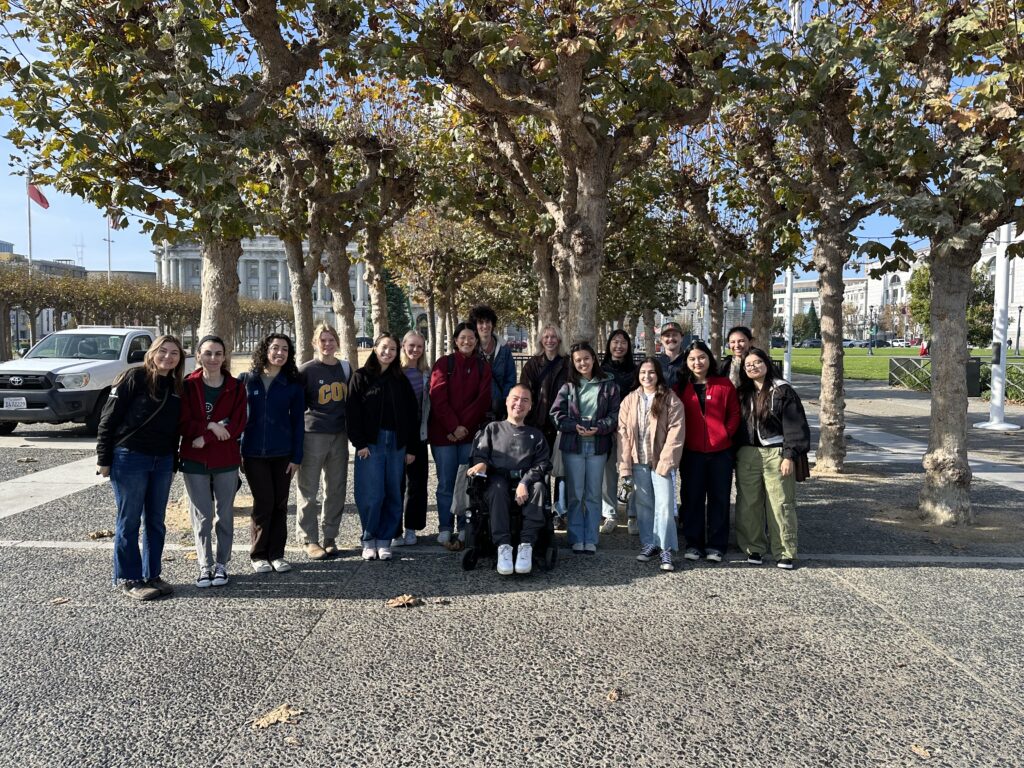
Description: CivicSpark Fellows volunteer with external organizations to serve communities and deepen their understanding of community resilience issues “on the ground.” Fellows are required to participate and typically provide direct support while working alongside community members and leaders. Common examples include addressing food insecurity by serving with food banks or community gardens, and habitat restoration through cleanup or planting.
I remember thinking, “This is what Sacramento must look like.”
Or maybe it was Washington, D.C., or the UN?
The one in New York, of course. As an American, I wouldn’t have a clue what the built environment of Switzerland, Austria, or Kenya would look like.
But it was something like a government center. Somewhere where vetted men in fancy suits, with a briefcase in one hand and an encrypted flip phone in the other, would be. In either case, it was the first time I had ever been to that sort of place.
Stepping onto the Civic Center / UN Plaza station, it was already 10:25am. I was supposed to meet the other Bay Area Fellows in five minutes, and I still hadn’t identified where the UN Plaza Stairs Entrance / Exit was. Luckily, this was not my first time in San Francisco or on the BART, but it was my first time at this station. It was also the first time all of us would be meeting in person, and I had an irrational fear that if I didn’t arrive exactly at 10:30am I would be left behind.
Luckily, I was able to locate an exit almost immediately. I quickly jogged up the stairs, emerged onto the wide-paved sidewalk, briefly took in the cityscape, and hurried down the designated path Google Maps laid out for me. ETA was exactly five minutes.
Somewhere in the hustle of maneuvering around construction and crosswalks, I’d look up at the surrounding buildings and think: what would it be like to live and work in a city? Even amid the gray sky, cold morning, and hilly streets, the idea somehow seemed glamorous.
This sense of wonder only solidified once I stepped onto Fulton Plaza, an open space just in front of the Civic Center Plaza. Instantly, I was enveloped by neoclassical-reminiscent architecture that seemed to point to an important place. Indeed, even dressed in baggy, military green cargo pants and a roomy black denim jacket, I felt I carried a sense of importance by proxy.
After crossing what I now know to be Pioneer Monument, I spotted the group. Huddled under a grove of trees, the handful of early 20-somethings hunched over in a meeting circle were hard to miss. With a grand city hall in the background and a walkway lined with international flags suggesting a focus on diplomacy, it was certainly quite the environment for forming first impressions.
What followed was a chorus of soft hellos. I then followed the group’s formation and awkwardly positioned myself near an open spot beside a girl I was sure I had seen and potentially even interacted with on a Zoom screen, though I couldn’t quite place her name. Online orientation capitalizes on the initial excitement of new beginnings but squashes the ability to connect and remember names to faces, no matter how many breakout rooms you’re in.
As we waited for our Fellow Advisor, Mariah Thompson, to provide instructions, I decided to make small talk. I found out the girl’s name is Tienna, that she works on Workforce Development with the San Jose Conservation Corps (one of the few other nonprofits in the program), and that she also happens to be from Berkeley (along with a surprisingly few other Bay Area Fellows). She attended UC San Diego, where she majored in Urban Studies.
Just as soon as I was about to answer all the questions I bombarded her with, our conversation was cut short when Mariah introduced herself, a new CivicSpark staff member, Hector Rodriguez, and asked us all to do the same via a series of icebreakers.
The next hour and a half were spent discussing a number of important matters, such as what kind of smell and/or noise we would like to exude and/or make when we walked into a room. Most answers were to be expected: the smell of lavender, fresh-baked cookies, and clean laundry (mine), but there were also some unique ones, such as the sound an alarm makes when a train arrives at a Tokyo station. For sound, I had said the sound of leaves crunching, but just as soon as my turn was over, I thought the sound of Steve walking around a grassy field in Minecraft was a much more memorable answer. Missed opportunity.
At 11:00am, it was time for lunch. We walked three blocks northeast to our reservation at Golden Era Vegan Restaurant, an Asian-fusion take on vegan meals. Only two other pairs of people seemed to be in the mood for tofu and noodles that chilly Monday morning.
I ended up seated at the edge of a makeshift elongated table alongside two Metropolitan Transportation Commission (MTC) Fellows, Lev and Ryan, as well as Hector. In one of our many icebreakers, Ryan described himself as rambunctious, but I found him to be quite the opposite: he was calm and had great comedic timing. Lev described himself as lax, and I found that pretty accurate, but I would also add that he was kind and soft-spoken.
After a hearty meal of spring rolls, friend wontons, and a very filling black sesame latte, it was time for our Service Day to officially begin. Around 12:15pm, we gathered our belongings and trudged up two and a half blocks to our volunteer site, Project Open Hand.
We were greeted by Volunteer Coordinator Kelly Wong. Kelly passed out hair nets while she explained the organization’s work and the importance of food safety. Because meals are often tailored and delivered to those with compromised immune systems, it is crucial not only to be mindful but also diligent about washing our hands and changing gloves to avoid cross-contamination.
Then Kelly broke the bad news: our volunteer shift required us to split into two groups: one in the kitchen preparing vegetables and the other in the warehouse portioning and packaging ingredients. For someone who was looking forward to spending more time together as a cohort, this was a bit of a blow. All the while, it was understandable. I opted to be part of the warehouse group.
The warehouse group was led to the second floor by Operations Supervisor Maria Raquel Edora. For some reason, I expected the “warehouse” to be much bigger, a space similar to the size of Costco (mainly because that was the only warehouse-type building I had ever been in). That being said, it wasn’t small. It looked like any other food-grade packaging facility: gray. Steel tables lay on the floor, a steel hand-washing station for at least three people sat nearby, and a floor-to-wall steel freezer stood around the corner.
Like cells in mitosis, our divided group split further into two. Three of us would scoop, weigh, and seal bags of red beans; four would separate, portion, and seal bags of frozen tilapia; and the odd one out would label clear plastic bags used for packaging ingredients. In these groups, we each had our own hyper-specific role designed to maximize the rollout of red bean and tilapia packages.
Over the course of three and a half hours, my team and I became a well-oiled machine. Reminiscent of a 1920s Ford assembly line, Lev, Hector, Isabella (City of Pacifica), Jenna (County of Alameda), and I mastered the method of unboxing frozen fish, separating them into two, sealing the plastic bag under the heating machine with the right amount of pressure and timing, and organizing them into a crate before placing them in their arctic-like walk-in freezer.
At the end of our shift, both groups expressed our thanks to Kelly and Maria for their help and time, and we reconvened in the waiting room to debrief on our experiences with Mariah and Hector. Both groups took a strange (or maybe expected) amount of pride in the number of packages and pounds of food prepped, which briefly turned into a middle-school-esque competition. The kitchen team boasted that they peeled and diced 120 pounds of potatoes and cut 90 pounds of broccoli into florets, whereas the warehouse group countered by noting that we bagged 350 8-ounce bags of dry red beans and packaged 810 boxes of tilapia, which seems much more impressive in my unbiased opinion. But who’s counting? (The operation coordinators.)
Overall, we all expressed our gratitude for the opportunity to get to know the organization and lend a hand where it was needed. I know that, personally, I deeply appreciated the behind-the-scenes look at the amount of labor and people it takes to maintain a not-for-profit food bank in two of the largest cities by population in the Bay Area. It was also helpful for me to have a greater awareness of how much a non-profit can do and how critical their work is for many individuals, especially those who are most vulnerable and often overlooked. The Nuestro Canal, Nuestro Futuro initiative I am helping support at Canal Alliance is similar in that way. My experiences at my host site and at the food bank reiterated the impact community-driven non-profits have on individuals, particularly those most susceptible to slipping through the cracks. Organizations such as Project Open Hand and Canal Alliance work to ensure that doesn’t happen.
About Project Open Hand
Located in the Tenderloin District of San Francisco, Project Open Hand is a not-for-profit organization dedicated to providing medically tailored, nutritious meals to people recovering from illness, people living with disabilities, people who are homebound, and the elderly. Project Open Hand prepares more than 2,500 life-sustaining meals every day to help people fight illness and cope with the challenges of aging. They also provide healthy groceries to more than 200 clients who visit their two grocery centers each day. At both their San Francisco and Oakland locations, Project Open Hand relies heavily on volunteers to carry out its mission of improving the health and quality of life of its clients.
Project Open Hand offers flexible, varied volunteer opportunities for individuals and groups alike. From prepping and packaging meals to serving food across 13 community centers, delivering meals by foot or car, and assisting with special events such as Smuin’s Christmas Ballet LGBTQ Night on Dec 27th, they have a range of opportunities. They also visit hot spots, sites where immediate help is most needed. Volunteers can lend their time either on a weekly basis (with a three-month minimum commitment) or as time becomes available (recommended: hotspots and special events).
Project Open Hand relies strongly on volunteers to keep its operations going. However, individuals who may be unable to volunteer and would like to help further Project Open Hand’s mission can help them reach their end-of-year goal of raising $600,000 by making a financial donation or donating unused toiletries. Licensed food service providers such as restaurants, bakeries, and grocers can also directly donate excess food by reaching out to [email protected].