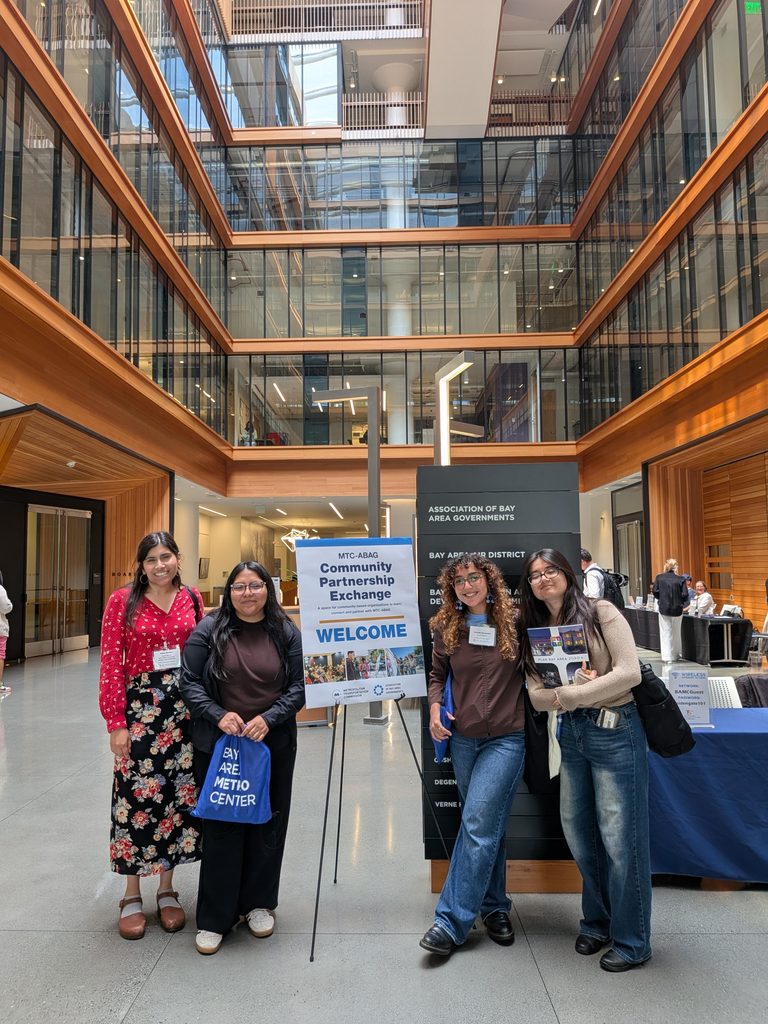
Diana Benitez, Sheila Alvarez, Isabelle Hernandez, and Daisy Alvarez
Canal Alliance brings local knowledge and community experience to regional decision making.
What does a meaningful partnership between a regional agency and a community-based organization look like?
For Diana Benitez, Senior Planner at Canal Alliance and Vice Chair of the MTC- ABAG Community Advisory Council, it starts with recognizing the expertise community-based organizations bring to the table. Community-based organizations are often closest to the people most affected by regional decisions. Their expertise comes not only from technical knowledge, but from trusted relationships and years of building power alongside residents.
On August 24, 2026 Diana delivered opening remarks at the inaugural Community Partnership Exchange, hosted by the Metropolitan Transportation Commission and Association of Bay Area Governments, known as MTC-ABAG. She joined Canal Alliance colleagues and many other community-based organizations (CBOs) from across the bay at the gathering, which created an opportunity for organizations and the regional agency to connect, learn from one another, and explore stronger ways to work together. “Meaningful partnership means meeting organizations where they are and connecting what’s happening locally to regional work,” Diana said in her remarks.
Strong partnerships between regional agencies and community-based organizations do not happen automatically. They require ongoing dialogue, trust-building, and a willingness to learn from one another. When those relationships are strong, it leads to more equitable planning processes and decisions that reflect community realities and reach residents who are often left out of decision making.
Bringing the Canal’s experience to regional conversations
Since 1982, Canal Alliance has worked alongside Latino immigrants and their families in Marin to help them build safe, secure, and successful lives. More recently, Canal Alliance’s work has grown to include community capacity building and training, supporting Marin’s Latino community in building power. Our community power-building work is rooted in San Rafael’s Canal neighborhood, where residents face challenges including overcrowding, housing instability, and the growing impacts of sea level rise.
Through our Strong & Resilient Communities focus area initiatives, Canal Alliance helps strengthen resident leadership and ensure community voices are part of the decisions that affect their lives. This experience, in turn, informs our conversations with regional agencies about what equitable community engagement strategies can look like, ensuring that these conversations are never one sided.
As an example, in December, Canal Alliance staff visited the regional agency to share lessons on engaging Canal residents in Plan Bay Area 2050+. In April, MTC-ABAG’s Public Engagement team visited the Canal to learn about local challenges and priorities, as well as Nuestro Canal, Nuestro Futuro, our community led neighborhood planning initiative that centers resident voices in decisions about the Canal’s future.
The Community Partnership Exchange reflected many of the ideas that emerged through these ongoing conversations. The event created space for community-based organizations and agency staff to build relationships, learn from one another, and discuss how to make engagement and partnership more meaningful. For Canal Alliance, it demonstrated a growing recognition that community organizations are not just outreach participants in regional planning efforts, but partners whose expertise can help shape programs, policies, and shared decision-making.
Creating space for organizations of all sizes
At the Exchange, organizations of all sizes were represented, from long-established non-profits to newer groups just beginning their work in the community. For Diana, this mix was important, because meaningful partnership also requires recognizing that organizations have different levels of capacity to engage with regional initiatives from long-range planning efforts like Plan Bay Area to housing, transportation, and environmental programs that affect communities across the the region.
“Some organizations may have the capacity to engage more deeply, while others may contribute at a smaller scale,” Diana said. “Both have important expertise to offer, and both should have a place at the table.”
That means creating partnerships that make participation possible, including compensating CBOs for their time and expertise, making contracting and reporting easier to navigate, and creating scalable ways for organizations to participate.
It also means learning from one another. Regional agencies can learn from the local knowledge, relationships, and engagement expertise that community organizations bring. CBOs, in turn, can learn from regional agencies and from their peers across the region.
This approach reflects Canal Alliance’s broader Policy, Advocacy and Civic Engagement work, which works to elevate community voices and address inequities affecting the Canal neighborhood and Latino and immigrant communities across Marin.
The Community Partnership Exchange represents another step toward building stronger connections between local communities and regional decision making. For Canal Alliance, the work ahead is not only about strengthening those relationships but ensuring that community knowledge continues to shape decisions that affect residents across the Bay Area.
Learn more about how Canal Alliance is working alongside residents to build strong and resilient communities in Marin.