By: Daisy Alvarez – Policy and Civic Engagement
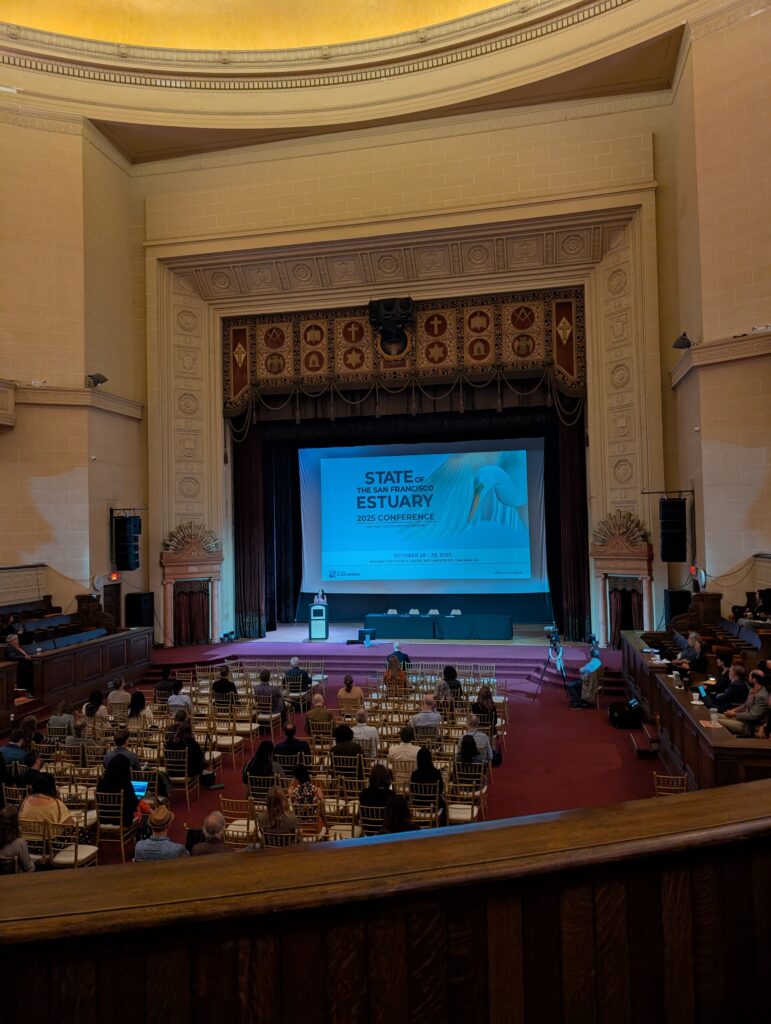
I was fortunate to have attended the 2025 State of the San Francisco Estuary Conference in Oakland, CA. As a recent graduate and early career professional, this was my first official conference, and it turned out to be an enlightening experience. I was surrounded in a room full of passionate professionals who are dedicated to actively working on adequately adapting their community to climate-induced threats, including sea-level rise and water quality.
I want to highlight the keynote speech and the two sessions that I attended. To start the morning off, I heard an inspirational speech from a climate and labor advocate, Elise Joshi, who spoke about leveraging social media as a tool for educating and mobilizing youth to take a stance to fight for a sustainable future during COVID-19. Joshi is two years older than myself yet hearing her speak so eloquently about her work and addressing a room full of mid-career professionals left an impression on me.
As for the sessions, I attended “Bringing Resilience Home: Global & National Adaptation Strategies Envisioned in our Estuary,“ where I heard Dutch-born water management consultant and Vice President of Arcadis, Edgar Westerhof, highlight implemented coastal adaptation projects, from Rotterdam to Norfolk, Virginia.
Next, UC Davis Professor of Environmental Science and Policy, Mark Lubell, presented his research on polycentric governance and underscored the importance of collaboration and its ability to drive change.
Lastly, I heard from Founder/CEO of the Center for Sea Level Rise Solutions and Candidate for Lt. Governor of California, Janelle Kellman. In addition to being an active figure in Marin County and giving a shout-out to Canal Alliance (whoot whoot!), Kellman emphasized the importance of community engagement (and no matter how you do, it’s never enough) which resonated as a Fellow for a CBO.
Kellman also unleashed her “secret weapon”—a framework on how to connect the masses to supporting climate resilience infrastructures: ports. I found this to be the most striking moment of the session because of how much truth I believe there is behind this theory. Kellman proposes elevating the role of ports to the national economy (40% of imports come in from the Port of Los Angeles and Long Beach) and framing it as a wide-spread economic disaster if the ports succumb to climate change. Framing the ports as a potential site of damage but also adaptation can have an enormous pull on the average American’s conscience. Kellman also suggests incorporating BlueTech and mobilizing a majority community college educated workforce as major players for implementation.
The session was moderated by Resilience Engineer at Arup, Jack Hogan, which was just the cherry on top.
The second session I attended was, “Tribal Water Issues: TBU’s, Bay Delta Plan Update, Delta Conveyance Project & The Role of Tribal Voices, Advocacy, and Water Protectors” where I heard from tribal members and advocates narrate their ongoing fight for agency and a clean Delta-Bay with the California State Water Resources Control Board. Coming from Southern California, I only have a surface-level understanding of historic and contemporary tribal relations and issues, mainly because my thesis focused on it. However, hearing from Gary Mulcahy of the Winnemum Wintu Tribe speak so effortlessly, humorously, and fervently speak about the water quality issues in the Delta-Bay, and its impact on tribes’ sustenance practices and ceremonial traditions–in addition to its broader environmental implications–and the failure of the Board to take accountability and be inclusive in its decision-making processes fully immersed me in their plight.
Sherri Noris of the California Indian Environmental Alliance also gave a presentation on the dangers of mercury levels and yet, its presence in every water system in California, other agency challenges, and their proposed solutions such as developing guidelines for the Board, processes for its internal staff, and updating the Delta-Bay Plan to include CLU’s and TBU’s (Tribal Beneficial Uses) and the Ocean Plan to include TBU’s.
A spokesperson for Malissa Tayaba, Vice Chair of the Shingle Springs Band of Miwok Indians, explained the importance of TEK’s, or Traditional Ecological Knowledge, emphasizing how they were created to presented as valuable for government boards. They also stressed how TEK’s are place-based, meaning knowledge differs from tribe to tribe, and how TEK’s should only be created by Indigenous people so that they can choose what information to share.
Lastly, Max Gomberg of the Shingle Springs Band of Miwok Indians (which, deceptively, is a band that encompasses other tribes and not just Miwok Indians) spoke to the current political climate and its impacts on the Delta-Bay. In addition to push-back from the California State legislature due to a fiscal concerns, confusion over definitions, and benefiting stakeholders such as big agriculture, Gomberg condemned Governor Gavin Newsom’s efforts to build the Delta Conveyance Project, a tunnel designed to pump water out of the delta, instead of pumping water in which is what it needs. He also condemned the governor’s efforts to expediate processes, including bypassing CEQA and other judiciary processes.
Gary closed off the session with a beautiful song to which everyone in the room stood up in respect.
My attendance would not have been possible without the support of Nayre Herrera, the rest of the PACE team at Canal Alliance, and a generous scholarship from the San Francisco Estuary Partnership that aims to: “ease financial barriers for members of small community-based organizations, Tribes and Native-led organizations, students and early career professionals, and people from under-resourced and/or otherwise marginalized communities.” Without the support of either, I would not have been exposed to such amazing talks or knowledgeable about any of the ongoing work being done to tackle shoreline and water quality issues in the Bay Area.
After attending this conference, I feel more informed of the key players working to support the estuary and the broader Bay Area. I now have a deeper understanding of local government processes, which is sure to inform my project at Canal Alliance, and feel more knowledgeable of projects that have positively impacted the built environment, information that will not only inform my current work but potentially my future career.